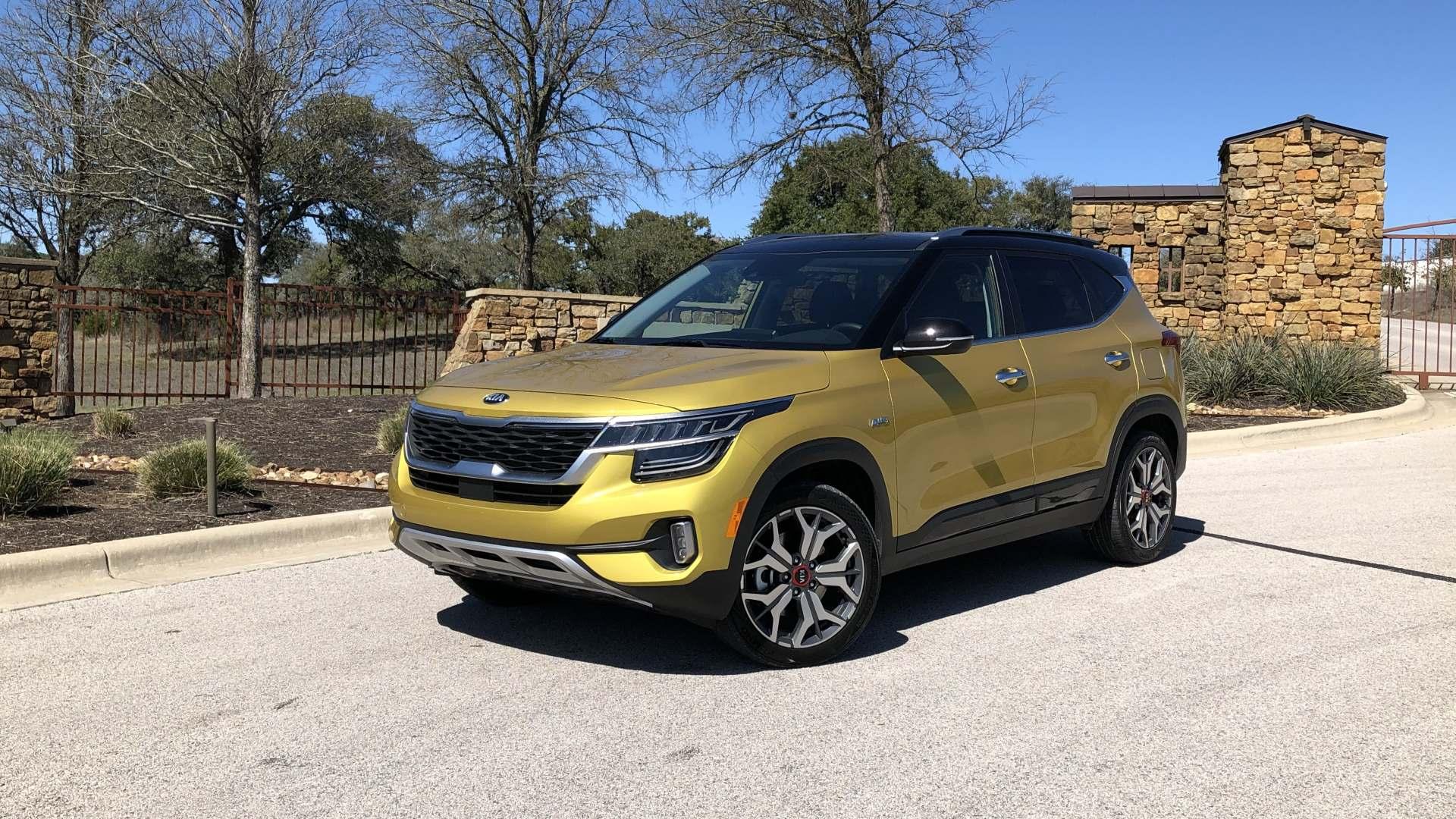
KIA Seltos 2021
Distinct from the Hyundai Kona… or not?
Pros and cons
Pros
- Lively turbo engine and dual-clutch transmission
- Solid and sound handling
- Roomy cabin
- Versatile trunk
- Generous standard equipment
- Simple controls
Cons
- Flabby two-litre engine
- No automatic emergency braking on the base model
- Soundproofing needs work
- Ride often stiff
Overview
Kia makes its move into the subcompact SUV segment with the new 2021 Kia Seltos. A couple of tall station wagons were on the books—the Soul and the Niro—but nothing with all-wheel drive or the standard sport-ute geometry. The Seltos aims to fill in that gap and conquer a broader range of the public. The mechanical affiliations with the Hyundai Kona are obvious enough, but Kia says it’s updated all the components to make this new kid on the block a vehicle like no other.
At $24,790 (including freight and preparation), the front-wheel-drive Kia Seltos LX ranks among the most affordable models in its class. Only its cousin from Hyundai sports a lower sticker price at the bottom end, and for that the sacrifices include a smaller cabin and a stingier set of standard equipment. All-wheel drive adds $2,000 to the Seltos LX, but it’s included on the other versions. The top of the line SX Turbo will run you $34,640, and its exclusive turbocharged engine (hence the name) delivers much more power than the basic power plant.
Kia builds the Seltos in South Korea.
Verdict
The 2021 Kia Seltos is a latecomer to the subcompact SUV party, but it was worth the wait. It’s well designed, technologically up-to-date, and impressively versatile for its size. Kia has, in keeping with the South Korean automotive tradition, adroitly pitched the equipment-to-price ratio while delivering a vehicle that’s a pleasure to drive. Too bad you have to shell out over $29,000 for the EX version to get automatic emergency braking, or almost $35,000 for the SX Turbo for an alternative to the sluggish base engine.
Evaluation
Body and cabin
Kia incorporated many styling cues of its big Telluride into the Seltos. Is it the boxy shape, the typically SUV proportions, or its generous size for the segment that makes the Kia Seltos so indisputably practical? Probably all three.One thing’s for sure, the cabin is among the most spacious and wide open in the category. That’s especially evident in the backseat, which accommodates two adults with generous legroom. Some of the Seltos’s interior dimensions even beat the Sportage—the next step up on Kia’s SUV hierarchy that sells for nearly $3,000 more.
The same also goes for cargo capacity, at least with the rear seatbacks folded down. Even when they’re up, the two-level floor and impressively long surface add up to one of the most usable trunks in the segment. Expect however the thin floor mat and cheap plastic sides to wear out well before their time.
The finish in the rest of the cabin is better. Hard plastic predominates there too, but that’s pretty much standard issue in the segment. The precise fit and contrasting trim do yield a welcoming environment all the same, as do the seats, which provide good support without overdoing it on the firmness. And in a display of the trickle-down effect applied to luxury and entry-level vehicles, you’ll find not just heated, but also ventilated, electric front seats in both the EX Premium and SX Turbo Seltos. Even backseat occupants are treated to heated seats in those versions.
The touchscreen, perched on the dashboard as per the current fashion, is the same rationally designed infotainment system found in other Kias. Both the 8- (LX and EX) and 10.25-inch versions (EX Premium and SX Turbo) have actual physical buttons and a pair of knobs that make the main controls easy to find and use. Android Auto and Apple CarPlay are right there, as are a couple of USB ports. The two top-of-the-line versions throw in a wireless smartphone charger, while the SX Turbo gets a Bose sound system as well.
The Turbo’s head-up display projects onto a plasticized lens that comes out of the top of the dashboard. Projecting onto the windshield is visually cleaner, but this approach remains convenient enough. Whatever the trim level, the old-fashioned dials and trip computer are just as user-friendly as the main controls. Add in the easy-to-adjust driving position, and the Seltos gets a sky-high score for ergonomics.
Safety
All models get a blind-spot and rear cross-traffic monitoring system. The LX trim however is short-changed on other advanced safety features, including automatic emergency braking, lane departure alert, lane-keep assist, and automatic high beams. It’s tough to justify such a strategy, given Kia’s late arrival in a segment where most of the competition has already read the writing on the wall. On the other hand, a rear occupant alert comes standard.Crash test results
National Highway Traffic Safety Administration (NHTSA)
Overall score: 5 / 5
Frontal impact: 5 / 5
Side impact: 5 / 5
Rollover resistance: 4 / 5
Insurance Institute For Highway Safety (IIHS)
Moderate overlap frontal impact: 4 / 4
Small overlap frontal impact:
- driver side: 4 / 4
- passenger side: 4 / 4
Side impact: 4 / 4
Rear impact: 4 / 4
Roof strength: 4 / 4
IIHS Top Safety Pick
Mechanical overview
Kia didn’t start with a blank slate when designing the 2021 Kia Seltos. It took the platform from the Hyundai Kona, then massaged and tweaked it to create its compact SUV. The adjustments included lengthening the wheelbase by 3 cm and giving the driving components an end-to-end update.Like the Kona’s, the Seltos’s rear suspension uses a torsion bar for the two-wheel-drive version and a multilink setup for the AWDs. Tunings however have been adjusted for the Seltos’s shape and weight, as well as for Kia’s specific handling objectives.
Under the hood are the same engines as in the Kona and the Kia Forte. Which is to say that the Seltos LX and EX both sport a 2.0-litre four-cylinder with traditional multipoint fuel injection. It’s been in service since 2017 in Hyundai’s Elantra sedan. Although it’s less powerful than Kia’s former 2.0-litre with direct fuel injection (146 hp vs. 161 hp), it seems to be more reliable. It is also more fuel efficient thanks to its Atkinson combustion cycle, often used in hybrid vehicles.
Unlike the Kona, which continues to stick with its classic six-speed automatic, the Seltos is endowed with the Hyundai Group’s newer continuously variable transmission. In automatic mode, it can simulate up to eight shifts as it keeps the engine from revving too high during strong accelerations. The eight gears can also be operated in manual mode using the shifter.
A direct-injected 1.6-litre turbo four-cylinder is exclusive to the SX Turbo. It pumps out 29 more horses than the 2.0-litre for a grand total of 175. But it’s the substantial boost in torque—delivered at lower rpms—that really makes an impression: 195 foot-pounds anywhere between 1,500 and 4,500 rpm vs. the base engine’s 132 foot‑pounds at 4,500 rpm.
Kia pairs that engine with a seven-speed dual-clutch automatic transmission that you can also shift yourself, which ensures that the turbo engine’s sporty side doesn’t get overlooked. This is Hyundai/Kia’s second generation of this type of transmission, and the group claims it’s more fuel efficient and robust, with better torque transfer.
Kia Canada’s data has the turbo engine’s combined city/highway fuel consumption at 8.7 L/100 km, a mere 5% more than the 8.2 L/100 km you’d burn with the 2.0‑litre.
All Kia Seltos come with standard all-wheel drive, except the LX, which offers it as an option (for $2,000). The system transfers a share of the torque to the back end when the front wheels lose traction. The driver doesn’t have to lift a finger, but there’s also a button to lock the power distribution and divide it equally between the two axles, to improve traction in deep snow, for example.
The Comfort and Sport drive modes adjust the accelerator response, gear shifts, and steering assistance. There’s also a Smart mode that switches back and forth between the two to match the way you’re driving.
Driving impressions
We previewed the Kia Seltos in Austin, Texas, a few weeks before the COVID-19 crisis hit North America. The up-and-down, winding roads in the area (Texas isn’t all plains—who knew?) gave us a chance to really explore its spry handling.The Seltos goes exactly where you tell it to, without much body lean on the curves. In other words, it’s solid and stable. The steering is, like the latest Forte5 hatchback, precise and well-weighted. The driver is not cut off from the road, Kia having avoided the excessive lightness that plagues so many of the Seltos’s competitors. Sport mode will stiffen up the response a bit more, but you don’t need that to make the Seltos fun to drive.
The low-profile 18-inch tires on our test model, an SX Turbo, no doubt contributed to that lively steering response. There’s little doubt either that they had a hand in the harshness of the ride on bumpy roads. In any case, we expect some of its rivals, like the Nissan Qashqai and the Subaru Crosstrek, would be more comfortable on cracked or buckling surfaces. The soundproofing struck us as needing some work as well, especially on rough pavement.
The turbo engine on the other hand outclasses the competition for flexiblity and mid-range oomph. It may not be a rocket, but it accelerates effortlessly whenever you want it to. The dual-clutch transmission is a fine partner too with its quick, fluid response. The slipping and hesitations of the system’s first generation are mostly just a memory.
It’s a shame that the turbo drivetrain is restricted to the priciest model, since the alternative 2.0-litre engine and continuously variable transmission aren’t really in the same class. They’ll keep up with city traffic just fine but are too wimpy to deliver enough pickup on the highway. Despite the efficient transmission, the 2.0-litre is also louder than the turbo. Which fortunately takes nothing away from all the rest that makes the Kia Seltos a truly winning proposition.